
Impeller Geometry Validation
Overview
As part of a strategic business decision, an end-suction water pump was introduced to a new market with significantly stricter hydraulic performance requirements. Although the pump had previously performed successfully in other markets, initial testing revealed that it failed to meet the new acceptance criteria despite no intentional design changes.
To investigate the issue, I was tasked with verifying whether the manufactured hydraulic components accurately matched their nominal CAD geometry. Using high-precision 3D scanning and deviation analysis, I compared production parts against their original 3D models to identify manufacturing variations that could explain the unexpected hydraulic performance.
Project Development
The investigation began with the inspection of several production impellers supplied by Flowserve's manufacturing facility in Coslada, Spain. The components were shipped to Budapest, where I performed high-precision 3D scanning using a FARO Quantum S FaroArm equipped with a Laser Line Probe.
After processing the scan data, I aligned the resulting meshes with the nominal CAD models and performed a detailed deviation analysis. This enabled a direct comparison between the manufactured geometry and the intended design.
Comparative Analysis
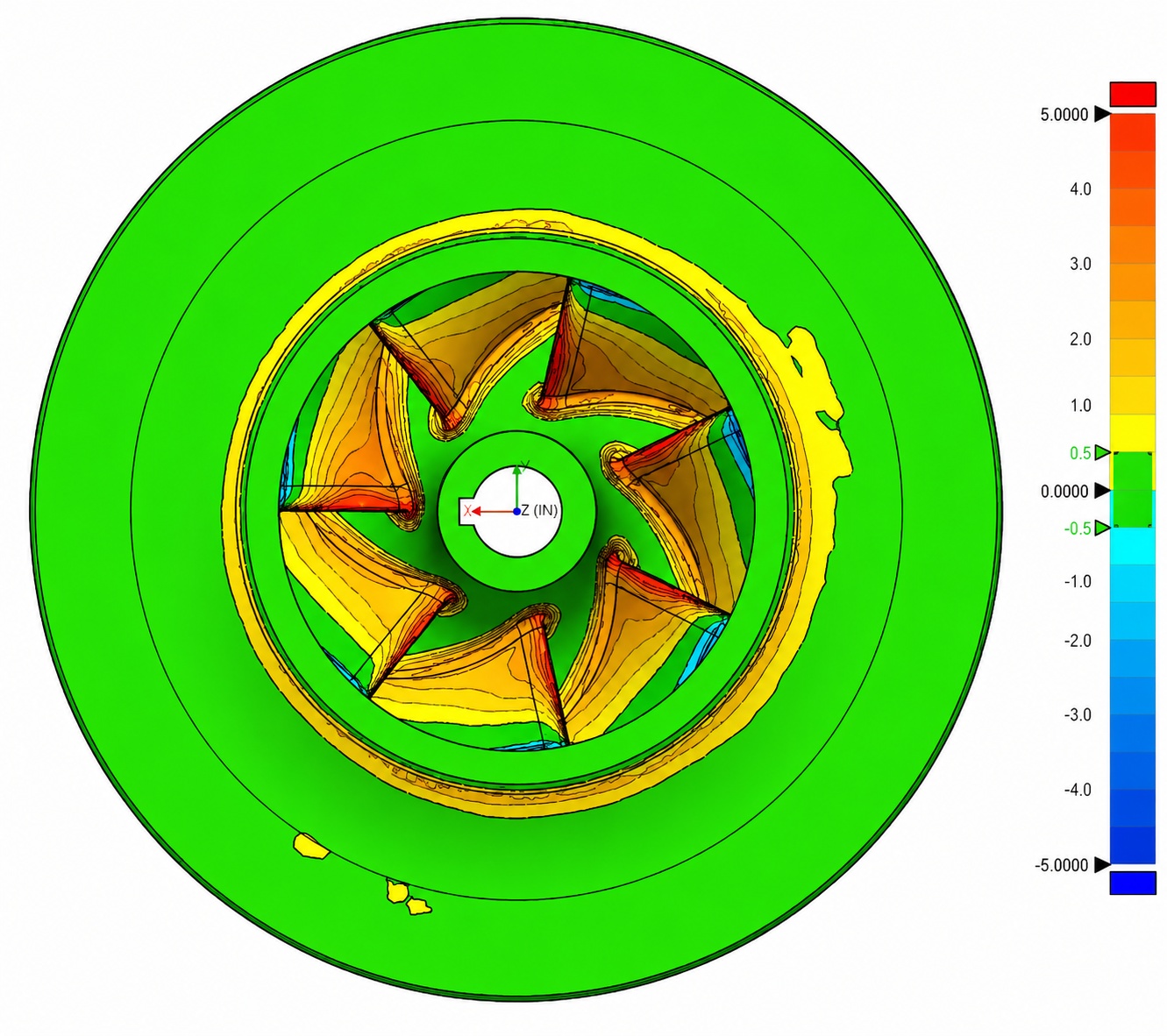
The inspection revealed consistent geometric deviations across multiple impellers. Areas of excess material were identified near the vane inlets, while material loss was observed along the back side of the vanes. The repeatability of these deviations indicated that they were systematic manufacturing variations rather than isolated defects.
The results suggested that the casting process introduced geometric distortion during the cooling phase, causing the manufactured impellers to differ from their intended hydraulic geometry.
On-Site Casing Inspection
Based on the impeller inspection results, the investigation was expanded to include the pump casings. Due to their size and weight, transporting the castings to Budapest was impractical.
Instead, I travelled to Flowserve's manufacturing facility in Coslada, Spain, where the equipment had been shipped in advance to perform the measurements on site. The additional inspections complemented the impeller analysis and provided a more complete understanding of the geometric condition of the hydraulic components involved in the investigation.
Outcome
The combined inspection results demonstrated that the casted components deviated significantly from their nominal CAD geometry. The identified variations provided a clear explanation for the unexpected hydraulic performance and helped establish the root cause of the issue.
The findings supported the engineering team in directing further corrective actions and contributed to improving the product's compliance with the hydraulic performance requirements of the new market.